
Build your personal German learning system
Every German learner needs different words. A beginner may need everyday vocabulary.
A student may need exam words. A worker may need business German. A university learner may need academic words. An advanced learner may need precise verbs and formal expressions. That is why fixed word lists are not enough. You need a personal vocabulary system.
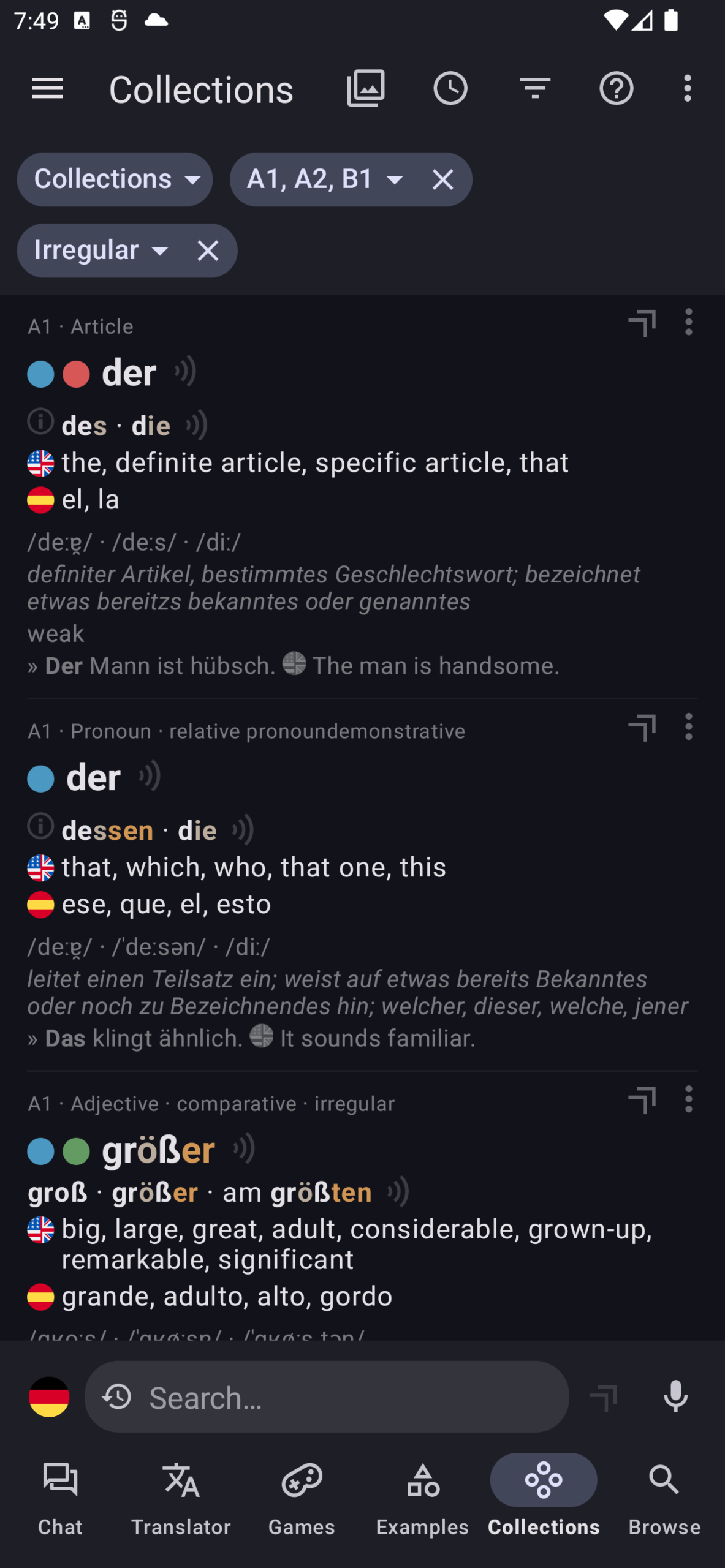
Netzverb German Dictionary App for Learners lets you save, organize, filter, import, export and practice German vocabulary through collections that connect with dictionary entries, examples, translation, games and AI chat.


Why vocabulary organization matters
Many learners collect words everywhere.
- Some words are in a notebook.
- Some are in screenshots.
- Some are in a flashcard app.
- Some are saved in a translator.
- Some are bookmarked in a browser.
- Some are forgotten completely.
This makes learning harder. The problem is not only vocabulary. The problem is vocabulary management.
If your words are scattered, you cannot review them easily. You cannot filter them. You cannot practice them regularly. You cannot see what you already know and what still needs work. Collections solve this problem.
Word lists should not become word graveyards
Saving words is easy. Learning them is harder. A vocabulary list can quickly become a graveyard of words you once wanted to learn but never reviewed. A useful collection should do more than store words. It should help you:
- Organize vocabulary.
- Open full word details.
- See examples.
- Use filters.
- Practice words.
- Focus on weak words.
- Prepare for exams.
- Import and export lists.
- Continue learning from saved words.
That is why collections should be connected to the whole learning flow.
What German vocabulary lists should include
German vocabulary needs structure. A useful vocabulary list should not only show:
- German word
- translation
It should also help with:
- Article and gender.
- Plural form.
- Verb forms.
- Meaning.
- Pronunciation.
- Examples.
- CEFR level.
- Grammar patterns.
- Synonyms and antonyms.
- Tags or categories.
- Practice status.
- Weak words.
This is especially important for German because the form of a word affects how you use it.
Popular ways learners organize German vocabulary
Learners often use:
- Notebooks
- Spreadsheets
- Flashcard decks
- Quizlet sets
- Anki decks
- Textbook lists
- Phone notes
- Screenshots
- Bookmarks
- Saved translator history
All of these can work. But they often require manual effort. You may need to copy words, add articles, find examples, check forms and build practice material yourself.
Netzverb German Dictionary App for Learners helps reduce that friction by connecting collections with the dictionary and learning tools.
How Netzverb German Dictionary Collections work
Collections help you save and organize German vocabulary. You can build custom lists, favorites and personal vocabulary sets. You can filter words by level, grammar and usage. You can import and export vocabulary lists. You can use collections directly in games.
Collections connect with the rest of the app. That means your saved words are not isolated. You can open dictionary entries, check examples, translate content, practice with games and ask AI questions. This turns vocabulary organization into active learning.
Example: a collection for B1 exam preparation
Imagine you are preparing for a B1 exam.
You may create collections for:
- Important verbs
- Nouns with difficult articles
- Words for writing emails
- Connectors and linking words
- Common expressions
- Work and daily life vocabulary
- Words from practice tests
- Weak words to repeat
With Netzverb German Dictionary App for Learners, these saved words can stay connected to grammar, examples, translation and games. This helps you move from collecting words to actually using them.
Example: a collection for articles
Many German learners struggle with der, die and das. A focused collection can help. You can save nouns that are difficult to remember and practice them regularly.
For each noun, you can check the article, gender, plural and examples. This is much better than trying to memorize nouns without structure. Over time, article learning becomes part of your vocabulary routine.
Example: a collection for verbs with prepositions
German verbs with prepositions are difficult because they often do not match other languages. Examples:
- warten auf
- sich interessieren für
- teilnehmen an
- sich erinnern an
- abhängen von
- sich bewerben um
- bestehen aus
A collection for these verbs can be very useful. You can save the verbs, check examples, translate sentences, ask AI for explanations and practice them later. This is exactly where connected collections become powerful.
Collections plus dictionary
A saved word should always lead back to full word details. With Netzverb German Dictionary App for Learners, collections connect to dictionary entries. This helps you review:
- Meaning
- Article
- Plural
- Conjugation
- Declension
- Pronunciation
- Grammar
- Synonyms
- Antonyms
- Usage
You do not need to build all information manually. The word stays connected to the dictionary.
Collections plus examples
Collections become more useful when you can see words in sentences. Example sentences help you remember how a word is actually used. This is especially important for:
- Verbs with prepositions
- Nouns with common verbs
- Formal phrases
- Idioms
- Abstract vocabulary
- Exam writing phrases
Netzverb German Dictionary App for Learners helps connect saved words with real examples, so you can learn context and not only translation.
Collections plus translator
Sometimes you want to organize vocabulary from translated text. For example:
- An email from work
- A school text
- A university document
- A message from a friend
- A form or instruction
- A phrase you want to say in German
Translation helps you understand the text. Collections help you keep the useful words. Together, they turn everyday German into learning material.
Collections plus games
A collection becomes powerful when you practice it. Netzverb German Dictionary App for Learners lets you use collections directly in games. This is useful because not every word needs the same attention. You can train:
- A specific collection
- Random words
- Filtered words
- Weak words
- Favorite words
- Words by level or topic
This makes your vocabulary lists active instead of passive.
Collections plus AI chat
AI can help you improve your vocabulary lists. You can ask:
- Which words in this topic are useful for B1?
- Can you explain the difference between these words?
- Can you create example sentences with my saved words?
- Can you help me practice these words in a dialogue?
- Which words are formal and which are everyday German?
Netzverb AI Chat helps turn saved vocabulary into conversation, explanation and practice.
Who should use German vocabulary collections?
Beginners
Create lists for basic nouns, verbs, articles, pronunciation and everyday phrases.
Intermediate learners
Organize verbs with prepositions, irregular verbs, case patterns and exam vocabulary.
Advanced learners
Build collections for formal German, academic words, synonyms, antonyms and nuanced usage.
Exam learners
Create focused lists for Goethe, TELC, TestDaF, DSH, school or university.
Multilingual learners
Use collections together with translations and support languages to compare meanings more clearly.
Why Netzverb Collections are different from simple word lists
A simple list stores words. Netzverb German Dictionary Collections connect words with learning.
Dictionary: open full word details.
Examples: see real usage.
Translator: understand meaning in your language.
Games: practice saved words.
AI Chat: ask questions and create practice.
Filters: focus on what matters.
This makes collections part of a complete German learning flow.
Continue learning
Read the full comparison:
Also useful:
Frequently asked questions
How should I organize German vocabulary?
Organize German vocabulary by level, topic, grammar difficulty, exam goal or personal relevance. Good collections can include articles, plurals, verb patterns, examples and practice status.
Are vocabulary lists useful for learning German?
Yes, but only if you review and practice them. A list alone is not enough. The words should be connected with examples, grammar and repetition.
Can I create custom vocabulary lists in Netzverb?
Yes. Netzverb German Dictionary App for Learners lets you save and organize vocabulary, build custom lists and favorites, and use collections for practice.
Can I import and export vocabulary lists?
Yes. Netzverb German Dictionary App supports importing and exporting vocabulary lists.
Can I practice my collections?
Yes. Collections can be used directly in games, so saved vocabulary becomes active practice material.
What should a German vocabulary list include?
A good German vocabulary list should include the word, meaning, article, plural, forms, example sentence, pronunciation and any important grammar pattern.
Turn saved words into learned words
Do not let your vocabulary lists become forgotten notes.
Save the words that matter.
Organize them.
Filter them.
Open examples.
Translate meanings.
Practice with games.
Ask AI for help.
AI is powerful. With Netzverb German Dictionary for Learners, you can move through the full learning flow in one app.
Learn German smarter!
All third-party product names, logos and brands are the property of their respective owners. This comparison describes general learning methods and publicly available app categories. Netzverb is not affiliated with the third-party apps mentioned on this page.